Fleet maintenance software for last-mile and delivery fleets
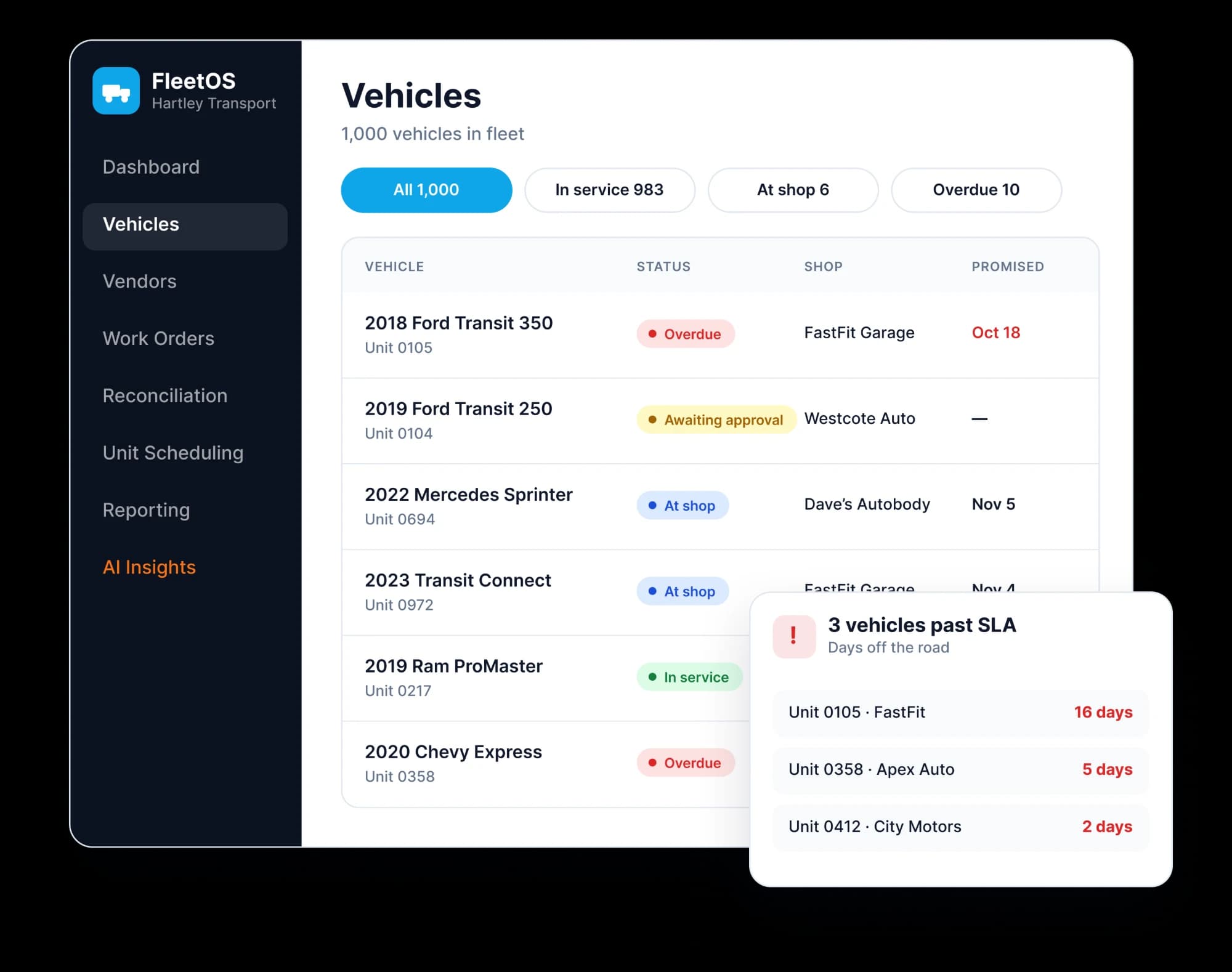
You run routes, not vehicles. A van that doesn't come back on Thursday is a route somebody has to cover on Friday. FleetOS puts every delivery vehicle on one live view — what's in repair and the day it's back, what's due for service, and which insurance, registrations and inspections are about to expire — and works with the shops you already use, with no software on their side.
Quick answer
Delivery fleet maintenance software tracks every van's service schedule, repairs, approvals, costs and compliance dates in one system. For a last-mile operation the part that matters most is visibility while a vehicle is at an outside shop: a van off the road is a route to cover tomorrow, and fleet operators generally price an idle vehicle at $500 to $1,500 a day. FleetOS puts every van on one live view — in repair, due for service or about to expire — keeps the repair, the approval and the return date on one record, and works with the shops a fleet already uses.
What FleetOS does for a delivery fleet
AI fleet administrator
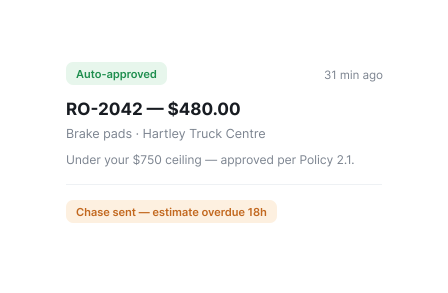
The AI fleet admin handles repair authorization, vendor coordination, and compliance, 24/7. Estimates clear against your own thresholds and rules, vendors that go quiet get chased, and exceptions escalate to a person.
Every vehicle, on one live view.
What's in repair and when it's back, what's due for service, and which insurance, registrations and inspections are about to expire — before the morning stand-up, not rebuilt from calls.
Any shop, no onboarding.
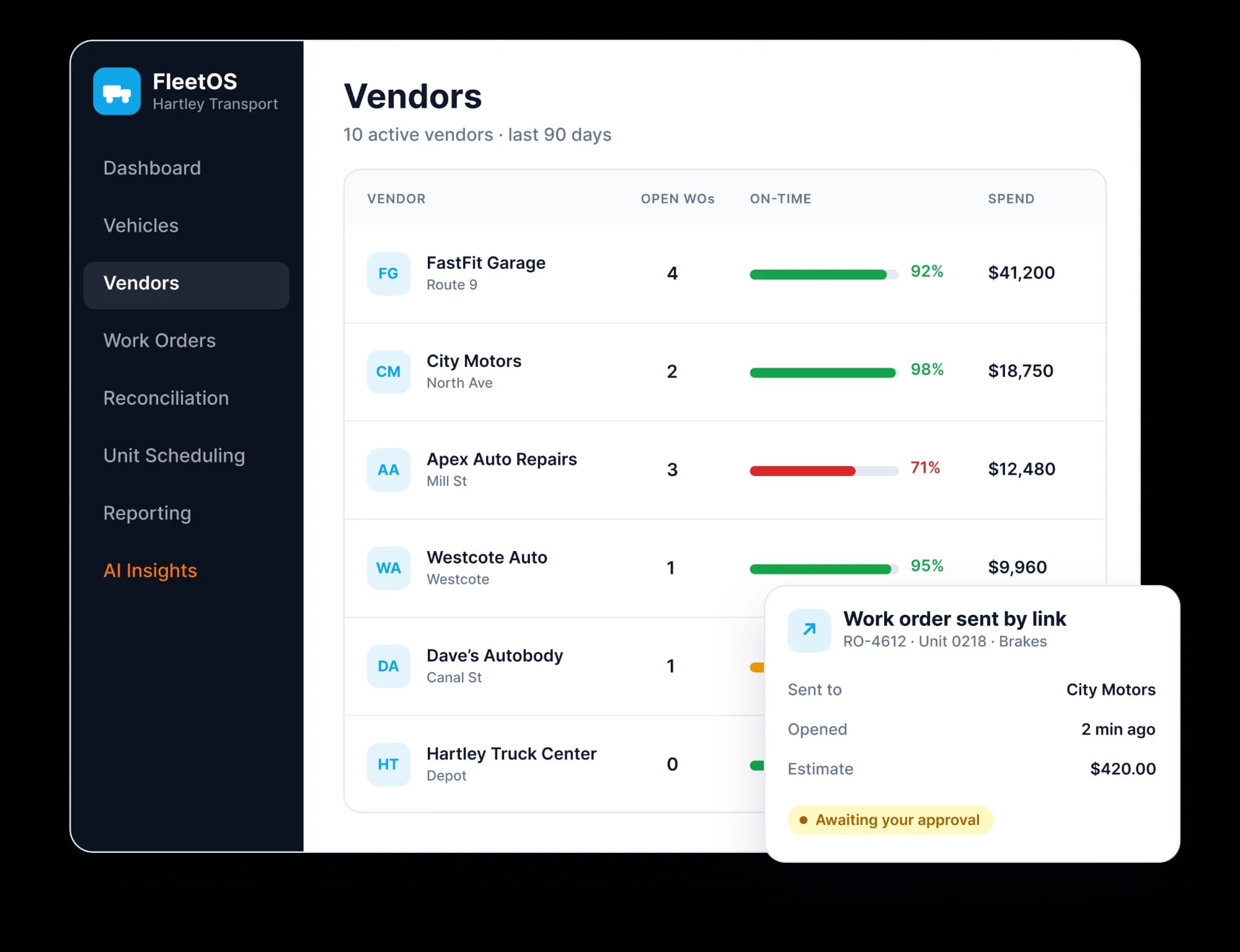
Work orders arrive as a link. The shop updates status, adds photos and sends estimates with nothing to install.
Service scheduled around the route.
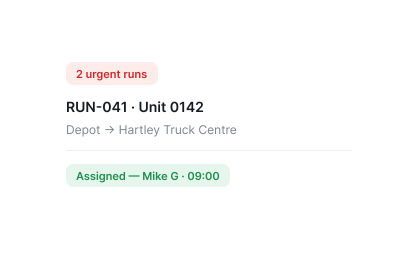
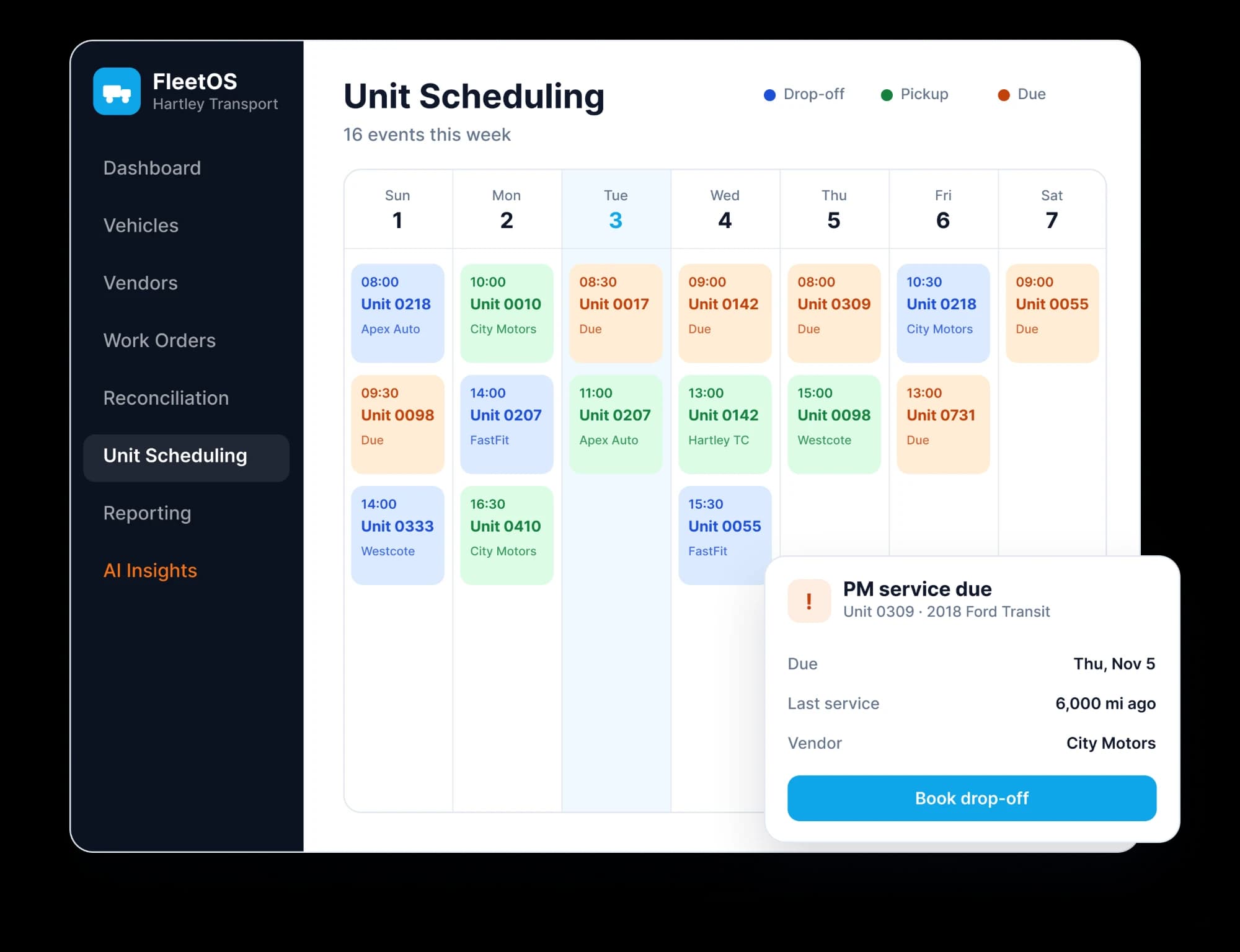
PM by mileage milestone, batched so only as many vans come off route per day as the depot can spare.
One record across every depot.
Vehicles, vendors and jobs on the same system whatever the metro, so spend and downtime compare without assembling it.
Compliance alongside the repair.
Inspection dates, insurance and registration renewals, and full service history on each vehicle.
What makes a delivery fleet different from any other fleet?
The vehicle is attached to a commitment that happens tomorrow morning whether it's ready or not.
A rental car can be swapped for another car. A delivery van is upfitted — shelving, a liftgate, refrigeration — and routed to a depot and a load plan, so the spare is rarely equivalent and the decision to pull it is made the afternoon before. That means somebody needs to know on Wednesday whether the van is back Thursday. It's the one answer most fleets can't get, and it gets harder with every depot and vendor added, because each relationship runs on a different person's phone and inbox.
What does a van off the road actually cost a delivery operation?
Fleet operators generally put an idle vehicle at $500 to $1,500 a day — the arithmetic is in what vehicle downtime costs a fleet operator.
For last-mile that's the floor. The costs that follow a missed route aren't invoiced: the short-notice rental, the overtime to redistribute stops, the idle driver, the service-level penalty. Then there's the spare-vehicle buffer most operations carry, sized against how wrong the return dates usually are — capital and depreciation spent to absorb uncertainty.
How do repairs get approved without the phone calls?
Routine repairs are approved automatically against rules the fleet sets once, so only exceptions reach a person.
Fleets already have authorization policy — a dollar threshold, a percentage tolerance, work that never needs a second look. It just lives in people's heads. In FleetOS those rules are set once, the AI fleet admin applies them as estimates arrive and chases vendors that go quiet. That removes the weekend problem: an estimate written Friday that sits unread until Monday, with parts unordered the whole time because parts can't be ordered until work is authorized.
Do the shops we already use have to adopt anything?
No — FleetOS works with the repair shops a delivery fleet already uses. That's deliberate.
Every work order reaches the shop as a link in an email or text, with no signup, no install and nothing for a service writer to learn, and it stays valid through the whole repair. Shops that want more can switch on ShopOS, full shop management software, with no software subscription when they use ShopOS Payments. Optional either way — you don't change vendors to use FleetOS.
How does preventative maintenance work on a high-mileage van?
Delivery vans hit service intervals fast, so the PM schedule drives your off-road plan rather than interrupting it.
FleetOS holds a PM schedule per vehicle against labor operations and mileage milestones. Vehicles approaching a milestone surface as due, and you build the week from there — capping how many vans come off route per day.
What about inspections and compliance records?
Inspection and renewal dates belong on the same record as the repairs.
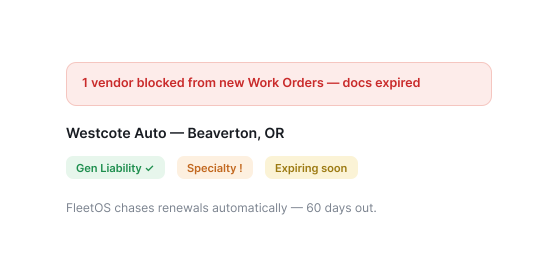
Most last-mile fleets run a mix of vehicles on different inspection schedules, which is why compliance tracking usually ends up as two systems and a spreadsheet. FleetOS keeps inspection and renewal dates on the same record as the repair history, so what's due sits next to what's in the shop.
What should a delivery fleet measure that it probably doesn't?
The measure most delivery fleets lack is downtime days split by cause.
Cost per mile and PM compliance fall out of paperwork you already keep. Almost no fleet can say how many days it lost to its own approvals versus parts versus shop capacity — and those three have different owners and different fixes. The place to start is one interval: estimate sent to estimate approved. More in how fleet operators measure maintenance performance.
Key facts
- A delivery vehicle off the road costs $500–$1,500 a day in lost revenue and fixed costs, before the cost of covering the route it was assigned to.
- Upfitted vans aren't interchangeable, so an unreliable return date forces a spare-vehicle buffer sized against uncertainty rather than demand.
- Parts are usually ordered only after approval, so approval delay and parts delay run sequentially rather than in parallel.
- Shops receive work orders as a link, with no signup or install, so a fleet doesn't change vendors to adopt FleetOS.
Delivery fleet FAQs
What is fleet maintenance software for delivery fleets?
Can FleetOS work with the repair shops we already use?
How does FleetOS reduce van downtime?
Does FleetOS track inspections and renewals?
Can we manage vehicles across multiple depots?
How is FleetOS priced for a delivery fleet?
Put every delivery vehicle on one view
What's in repair and when it's back, what's due for service, what's about to expire, and what it all cost. Your shops need nothing new.