Fleet maintenance software for municipal and government fleets
A city vehicle off the road isn't lost revenue — it's a service the public still expects. FleetOS puts every unit on one record, from the patrol car at an outside vendor to the refuse truck in your own garage, so the fleet manager can answer what's down, why, and when it's back without spending the morning finding out.
Quick answer
Municipal fleet maintenance software tracks service schedules, repairs, vendor work, cost and compliance records for a government fleet, across vehicle types that have almost nothing in common. What makes the public sector different is that the work doesn't stop when a unit does: the route still runs, the shift still deploys, the statutory service is still owed. FleetOS keeps in-house and vendor work on one record so a fleet office can see the whole picture without assembling it from calls.
What FleetOS does for a government fleet
AI fleet administrator
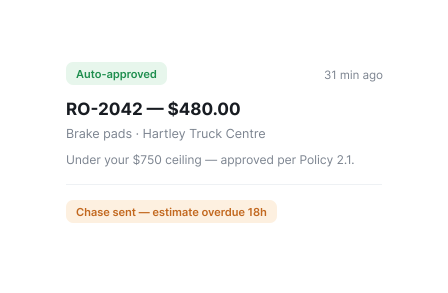
The AI fleet admin handles repair authorization and vendor coordination, 24/7. Thresholds and authority limits are applied to estimates as they arrive, with anything outside them escalated to a person.
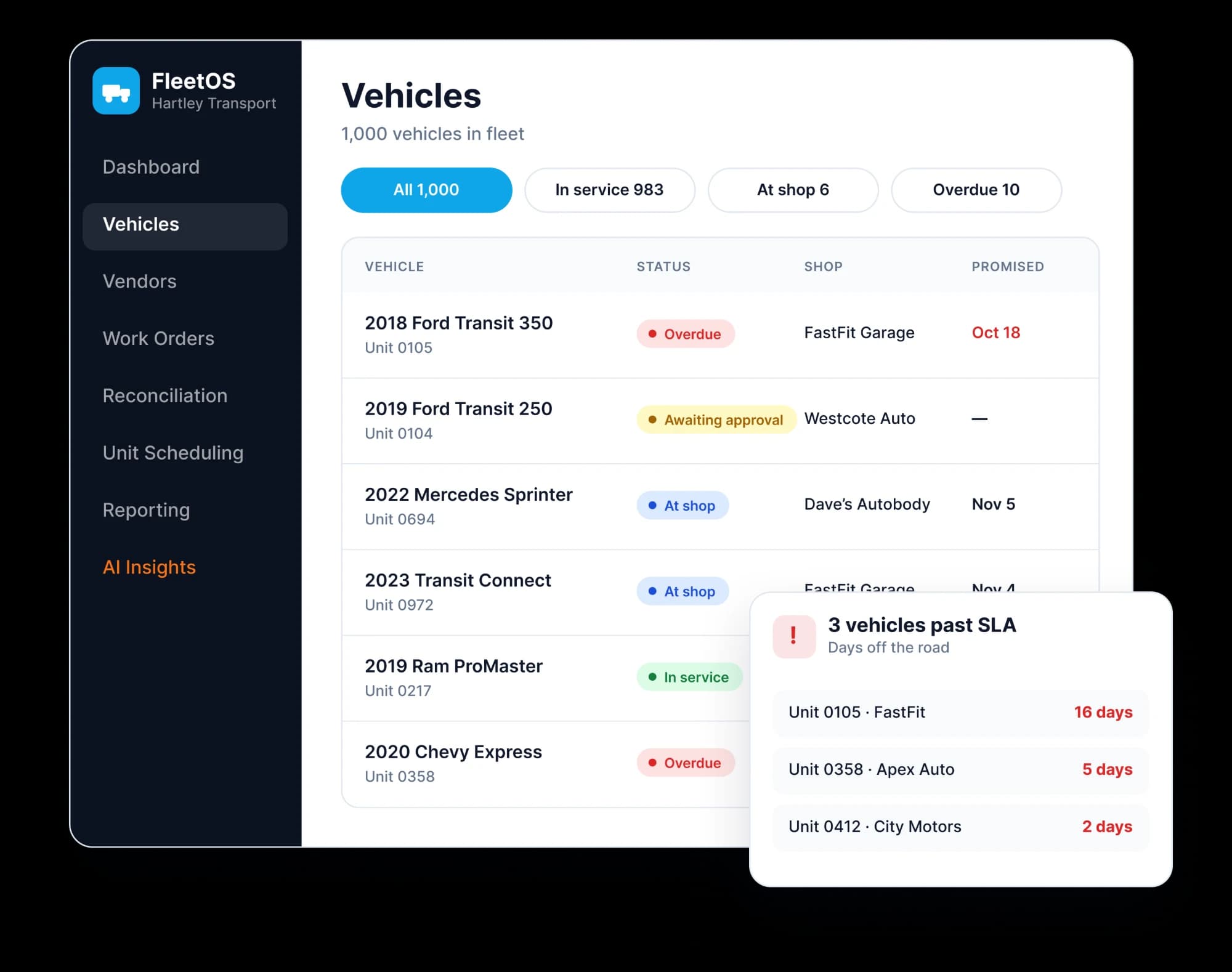
Every unit in one view, on the road or off it.
What's running, what's in repair and when it's back, what's due for service, and which insurance, registrations and inspections are about to expire — before the morning meeting rather than during it.
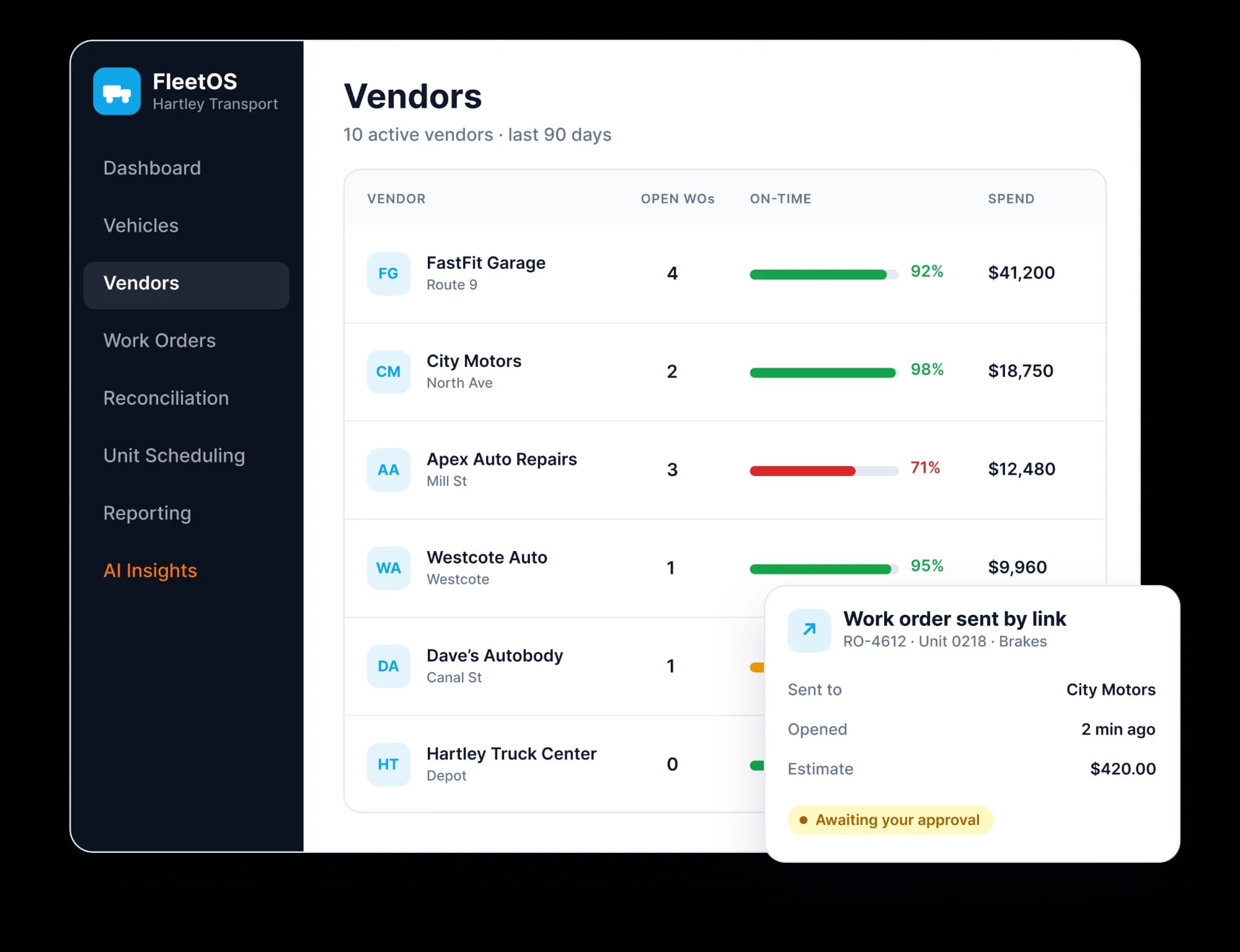
Any shop, no onboarding.
Work orders arrive as a link. The shop updates status, adds photos and sends estimates with nothing to install.
In-house shop and outside vendors together.
Work your own garage handles and work you send out, on the same record and the same cost history.
Batch scheduling for departments.
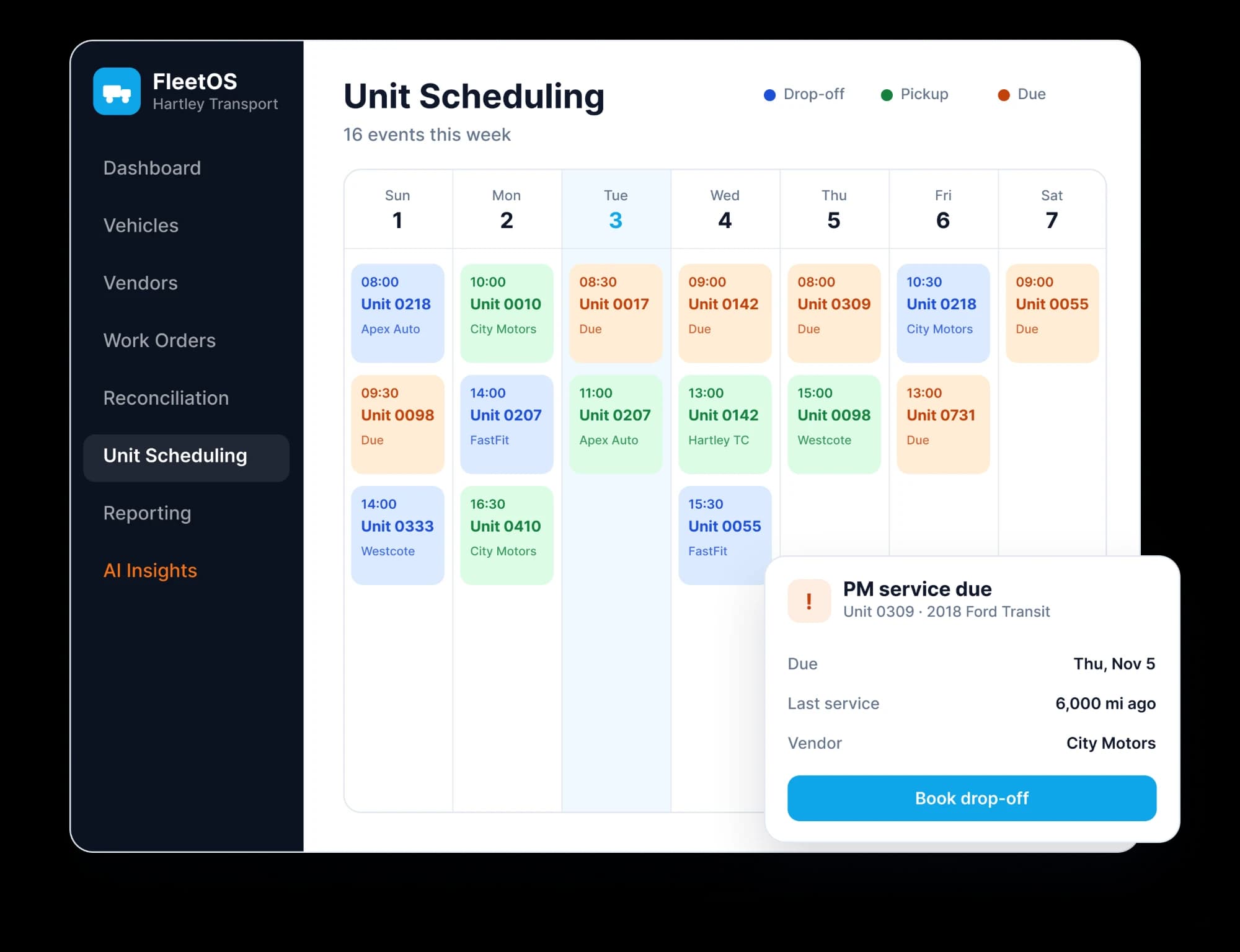
Group units for service — five on Monday, five on Tuesday — so a department takes a known number of vehicles out of service rather than losing them unpredictably.
Records that survive an audit.
Repair history, spend and inspection dates held per unit, by department and cost center.
What makes a municipal fleet different?
Two things, and together they make it the hardest fleet type to run well.
The asset mix is extreme. A single public works department might run patrol vehicles, refuse packers, street sweepers, vacuum trucks, plows, mowers and light pickups. Service intervals, parts, specialist vendors and failure modes share nothing. A system that assumes a uniform fleet of vans is the wrong shape from the first day.
Demand is statutory, not commercial. A private fleet can decline work when vehicles are short. A city cannot stop collecting refuse, and a police department cannot field fewer cars because three are at a shop. Downtime doesn't reduce output — it gets absorbed by overtime, hired equipment and staff working around the gap.
How do in-house shops and outside vendors sit together?
Most government fleets run both, and the split is usually where visibility breaks.
Routine work goes to the municipal garage. Specialist work, overflow and anything under warranty goes to an awarded vendor. Those two halves typically live in two systems, or one system and a phone, so nobody can answer a simple question — how many units are down across the whole fleet right now, and how many of those days are ours versus a vendor's.
FleetOS holds both on one record. The in-house job and the vendor job appear the same way, with the same statuses and the same cost history, so the comparison exists without anyone building it. That also makes vendor performance visible: turnaround, repeat work and spend, per vendor, which is the evidence a fleet office needs when a contract comes up for renewal.
Can we schedule units in batches by department?
Yes, and for fleets where the driver isn't the point of contact it's the only workable way.
A department manager who needs five units serviced doesn't want five separate conversations. They want to commit to a block — five vehicles a day, Monday through Wednesday — and know the rest of the shift is unaffected. FleetOS schedules against mileage milestones and lets work be grouped that way, so service capacity gets planned against what a department can release rather than arriving as a surprise.
How does this hold up to an audit?
Public money leaves a trail, and the trail has to survive questions asked a year later.
FleetOS keeps the full history per unit: what was done, by whom, what it cost, which department it sat with, and the inspection and renewal dates alongside it. That means a spend question can be answered from the record rather than reconstructed from invoices and memory — and a vendor's performance can be evidenced rather than asserted.
What should a government fleet measure that it probably doesn't?
Downtime days split by cause, broken out by department.
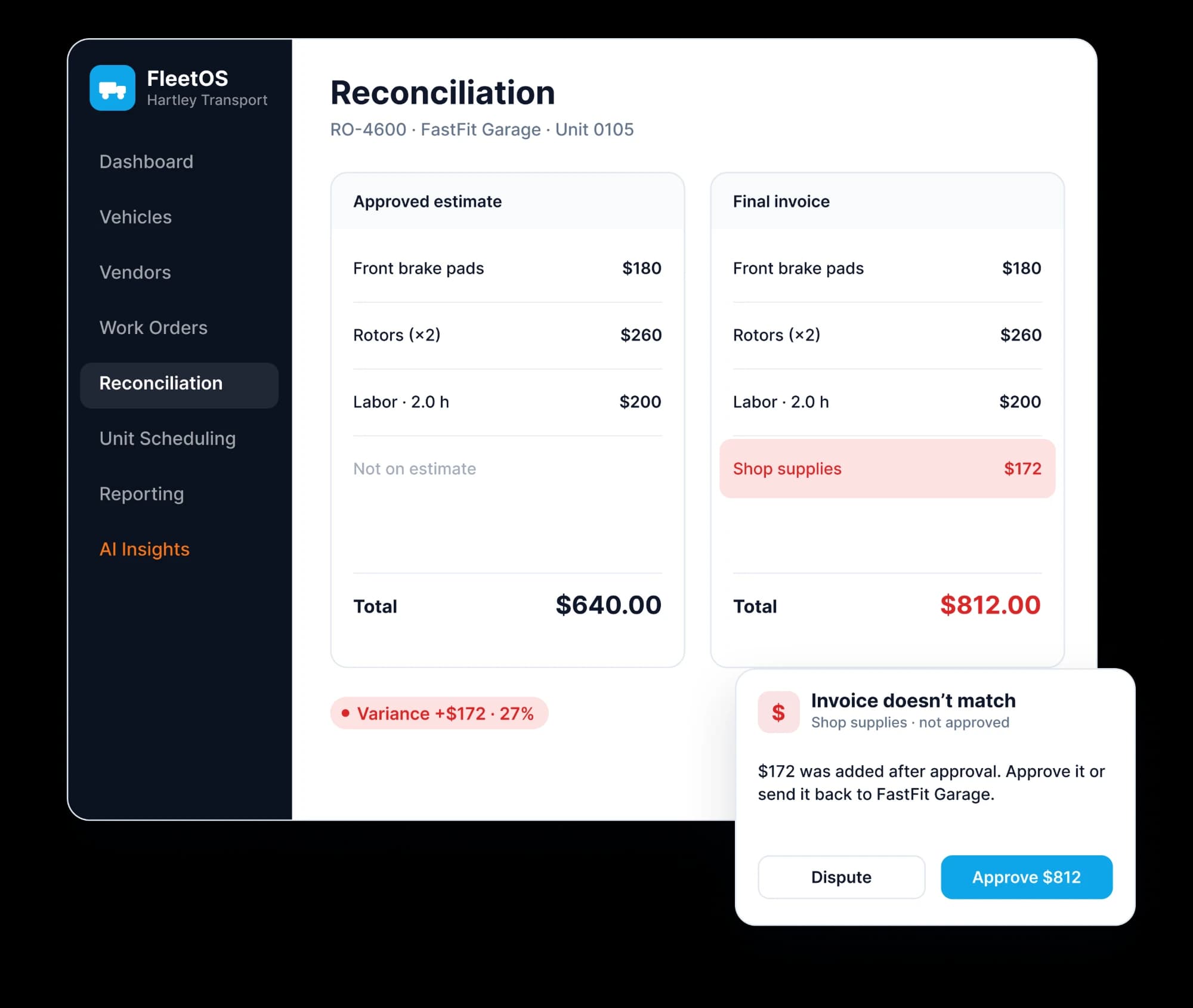
Most fleet offices can produce cost per unit and PM compliance, because both fall out of records already kept. Almost none can say how many days were lost to approvals versus parts versus their own garage's capacity — and those three have different owners and different fixes. More in how fleet operators measure maintenance performance.
Key facts
- Municipal fleets run asset types with no shared service intervals, parts or vendors, so a uniform-fleet system is the wrong shape for them.
- Public sector demand is statutory: downtime is absorbed through overtime, hired equipment and staff workarounds rather than reducing output.
- Most government fleets split work between an in-house garage and awarded vendors, which is usually where fleet-wide visibility breaks.
- Batch scheduling by department lets a manager release a known number of units per day rather than losing them unpredictably.
- Vendor turnaround, repeat work and spend become evidence at contract renewal only if they're recorded per vendor.
Government fleet FAQs
What is municipal fleet maintenance software?
Can FleetOS handle mixed assets like refuse trucks, plows and patrol cars?
Can we manage our in-house garage and outside vendors in one system?
Do our awarded vendors have to adopt anything?
Does FleetOS keep records for audit?
Put every unit on one record
In-house and vendor work, cost by department, and what's due or expiring, on one record. Your vendors need nothing new.