Fleet maintenance software for service and trades fleets
Your vans aren't the product, but nothing gets fixed, installed or serviced without them. A van in the shop is a technician without their tools and a day of booked calls that has to move. FleetOS puts every service vehicle on one live view: what's in repair and the day it's back, what's due for service, and which insurance, registrations and inspections are about to expire. It works with the shops you already use, with no software on their side.
Quick answer
Service fleet maintenance software tracks every van's service schedule, repairs, approvals, costs and compliance dates in one system. For a plumbing, HVAC, electrical or contracting business, what matters most is that a van carries a technician and their stock, so a vehicle off the road takes a day of billable jobs with it. Fleet operators generally price an idle vehicle at $500 to $1,500 a day. FleetOS puts every van on one live view, keeps the repair, the approval and the return date on one record, and works with the shops a fleet already uses.
What FleetOS does for a service and trades fleet
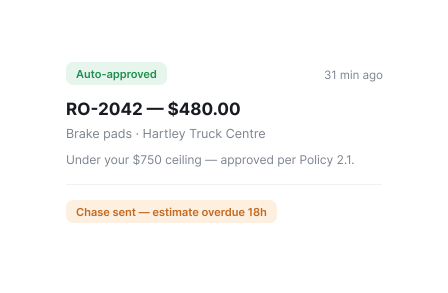
AI fleet administrator
The AI fleet admin handles repair authorization and vendor coordination, 24/7. Estimates clear against your own thresholds, vendors that go quiet get chased, and exceptions escalate to a person, so the owner or office manager isn't the bottleneck between a quote and a repair.
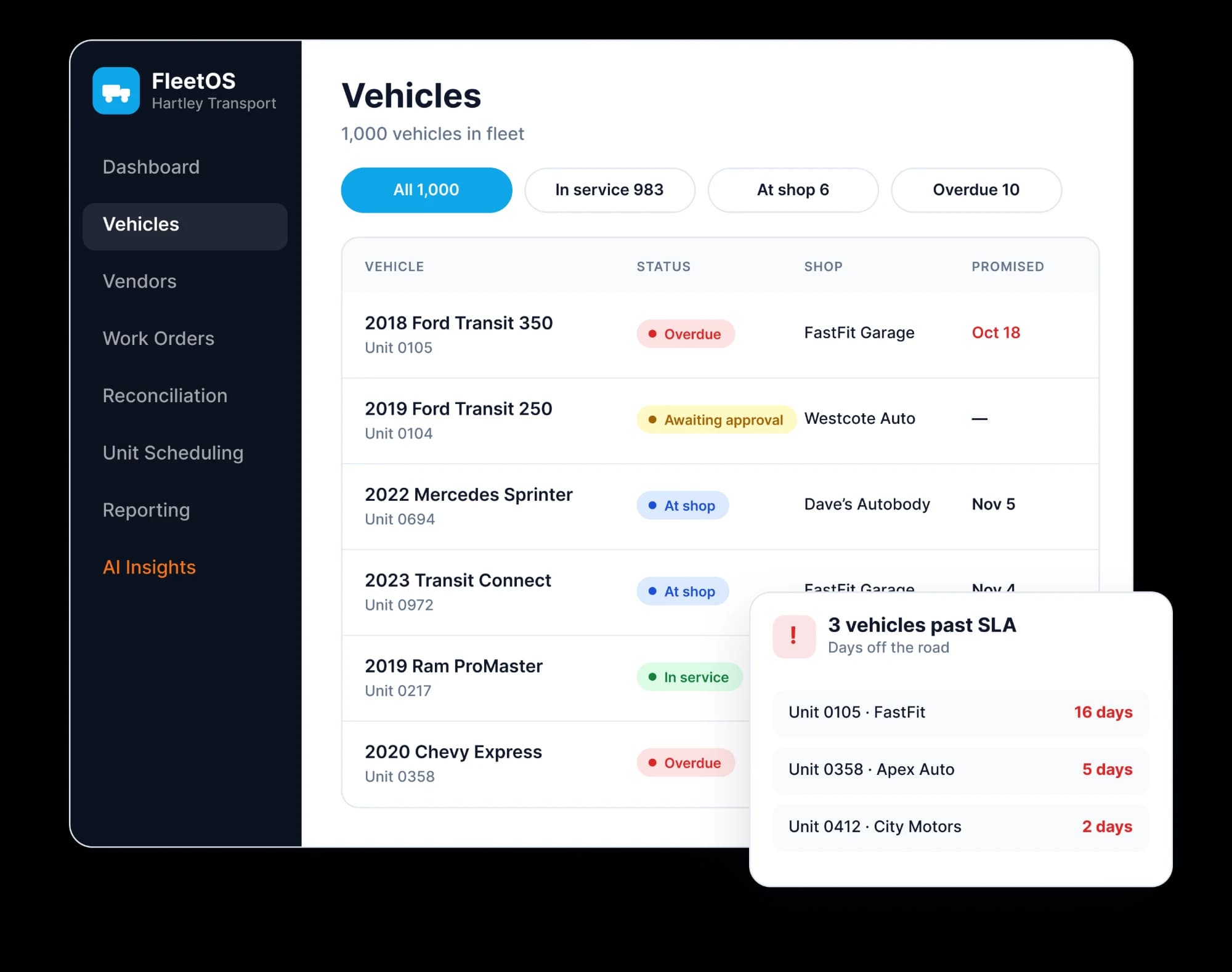
Every van, on one live view.
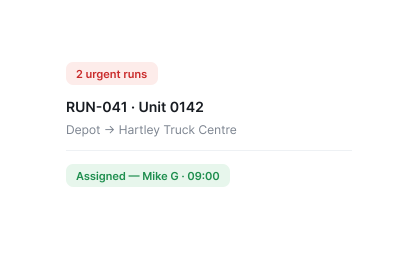
What's in repair and when it's back, what's due for service, and which insurance, registrations and inspections are about to expire, before the first job of the day is dispatched.
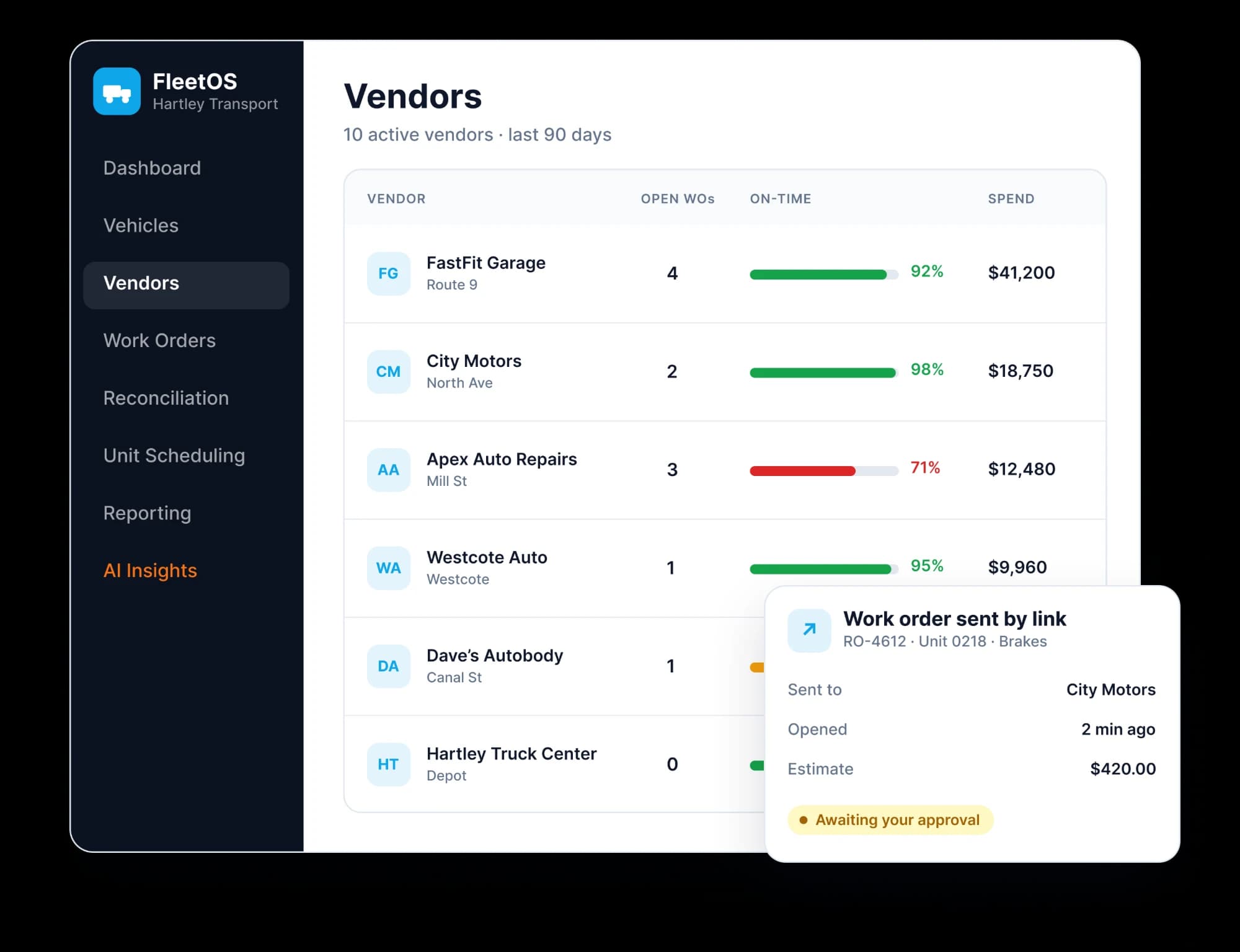
Any shop, no onboarding.
Work orders arrive as a link. The shop updates status, adds photos and sends estimates with nothing to install.
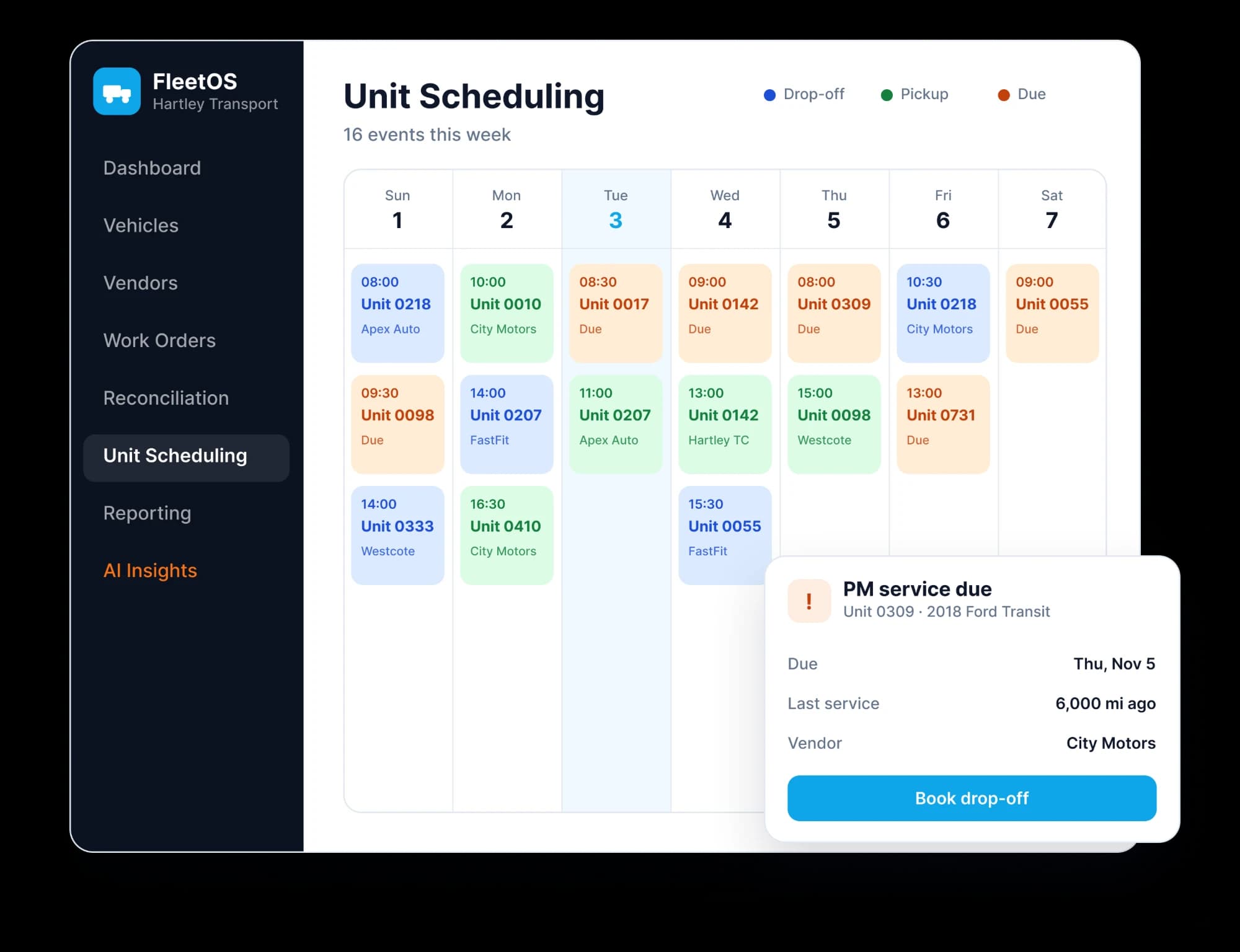
Service planned around booked work.
PM by mileage milestone, so a van's service lands on a light day rather than in the middle of a week of booked calls.
One record across every branch.
Vehicles, vendors and jobs on the same system whatever the location, so spend and downtime compare without anyone assembling them.
Compliance alongside the repair.
Inspection dates, insurance and registration renewals, and full service history on each vehicle.
What makes a service and trades fleet different from other fleets?
The van carries a skilled person and everything they need to finish a job, so it can't simply be swapped out.
A plumber's or electrician's van is a mobile stockroom: racks, shelving, parts inventory and specialist tools, set up the way that technician works. When it goes into a shop, a spare van, if there is one, arrives empty. The technician either loses the morning moving their kit across or works a reduced list of jobs. And because the van is booked against customer appointments rather than a route, the person who decides whether to send it in is usually the same person answering the phones.
What does a van off the road cost a service business?
Fleet operators generally put an idle vehicle at $500 to $1,500 a day, and the arithmetic is in what vehicle downtime costs a fleet operator.
For a service business the larger cost is the technician's day. A tech without a van can't bill, and the calls booked for that day have to be rescheduled, handed to someone already fully booked, or turned away. A customer whose appointment moves twice often books someone else next time. None of that shows up on the repair invoice.
Who approves repairs when there's no fleet manager?
Routine repairs are approved automatically against rules the business sets once, so only exceptions reach a person.
Many trades businesses don't have a fleet manager: repairs land on the owner or the office manager, between quoting jobs and dispatching technicians. An estimate that waits a day for a callback is a van that sits a day longer, and parts usually can't be ordered until the work is authorized (why parts delays cost more than the parts). In FleetOS the approval thresholds are set once, the AI fleet admin applies them as estimates arrive, and vendors that go quiet get chased without anyone picking up the phone.
Do the shops we already use have to adopt anything?
No. FleetOS works with the repair shops a service fleet already uses, often a local shop or two that knows the vans.
Every work order reaches the shop as a link in an email or text, with no signup, no install and nothing for a service writer to learn, and it stays valid through the whole repair. Shops that want more can switch on ShopOS, full shop management software, with no software subscription when they use ShopOS Payments. Optional either way: you don't change vendors to use FleetOS.
How do you fit preventive maintenance around booked jobs?
Plan service the way you plan the job board: ahead, and on the days that can absorb it.
Service vans often go home with their technicians, so getting one to a shop competes with that technician's appointments. FleetOS holds a PM schedule per vehicle against labor operations and mileage milestones. Vehicles approaching a milestone surface as due, so drop-offs can be booked into lighter days instead of discovered when a warning light comes on mid-job.
What about insurance, registrations and inspection records?
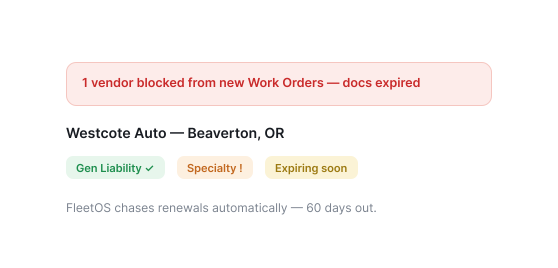
Renewal and inspection dates belong on the same record as the repairs.
A growing service business adds vans a few at a time, bought and registered in different years, so renewals stop lining up and the dates end up in a spreadsheet nobody owns. FleetOS keeps insurance, registration and inspection dates on each vehicle's record next to its repair history, so what's about to expire is visible alongside what's in the shop.
What should a service fleet measure that it probably doesn't?
The measure most service fleets lack is technician days lost to vehicle downtime.
Repair spend is on the invoices already. What almost no trades business can say is how many technician days went to vans waiting on an approval, a part or a shop's capacity, and those three have different fixes. The place to start is one interval: estimate sent to estimate approved. More in how fleet operators measure maintenance performance.
Key facts
- A vehicle off the road costs $500–$1,500 a day in lost revenue and fixed costs; for a service business the larger cost is a technician who can't bill and the jobs that have to move.
- Service vans are upfitted with tools and stock, so a spare vehicle is rarely a like-for-like replacement.
- Parts are usually ordered only after approval, so a slow approval delays the repair twice.
- Shops receive work orders as a link, with no signup or install, so a fleet doesn't change vendors to adopt FleetOS.
Service and trades fleet FAQs
What is fleet maintenance software for service and trades fleets?
Is FleetOS only for large fleets?
Can FleetOS work with the repair shops we already use?
How does FleetOS reduce van downtime?
Can we manage vans across several branches?
How is FleetOS priced for a service fleet?
Put every service van on one view
What's in repair and when it's back, what's due for service, what's about to expire, and what it all cost. Your shops need nothing new.